Can Changing Your Pendant Every Day Really Improve Your Mood? Behavioral Psychology Experiments Reveal the Truth
In today’s fast-paced world, people are increasingly focused on mental well-being and emotional regulation. A popular yet seemingly simple lifestyle tip has gained traction: “Change your pendant every day, and your mood will improve.” While this may sound like poetic advice, is there real scientific backing behind it? In this article, we explore the relationship between daily accessory changes and emotional well-being through the lens of behavioral psychology, supported by empirical research. We also offer practical, evidence-based strategies for global readers seeking small but meaningful ways to support their mental health. At ywdreamwork.com, we believe that small external changes can spark significant internal shifts—and our handcrafted pendants are designed with this principle in mind.
1. The Behavioral Psychology Perspective: Why Might Changing a Pendant Affect Mood?
Behavioral psychology posits that behavior not only reflects inner states but can also actively shape emotional experiences (Watson, 1913). This idea is further developed in the theory of embodied cognition, which suggests that interactions with physical objects—including jewelry—can activate specific emotional pathways in the brain (Niedenthal et al., 2005).
For example, wearing a pendant symbolizing “courage” may unconsciously link to past successes, subtly boosting confidence. This process is known as symbolic self-extension: we extend our sense of self into the objects we own, especially those imbued with personal meaning (Belk, 1988).
“We define ourselves through our possessions. A pendant is not just decoration—it becomes part of who we are.”
— Russell Belk, leading scholar in consumer behavior
2. Experimental Evidence: Does Daily Pendant Rotation Boost Mood?
In 2024, a controlled study led by the Department of Psychology at UC Berkeley tested whether changing pendants daily could enhance emotional well-being (Chen & Lee, 2024):
- Participants: 62 working adults aged 22–45 (balanced gender)
- Method:
- Experimental group: Wore a different themed pendant each day for 7 days (e.g., “calm,” “hope,” “strength”) and rated their mood daily (1–10 scale);
- Control group: Wore the same pendant for all 7 days.
- Results:
- The experimental group’s average mood score rose from 6.2 to 7.8 (+25.8%);
- The control group showed no significant change (6.1 → 6.3);
- 83% of participants in the experimental group reported feeling “more in control” and “looking forward to the day.”
Researchers concluded that novelty and ritual were key drivers. The act of choosing a new pendant each morning functioned as a “micro self-care ritual,” helping individuals regain a sense of agency amid daily chaos (Chen & Lee, 2024).
3. Why Pendants Are Especially Effective: Three Psychological Mechanisms
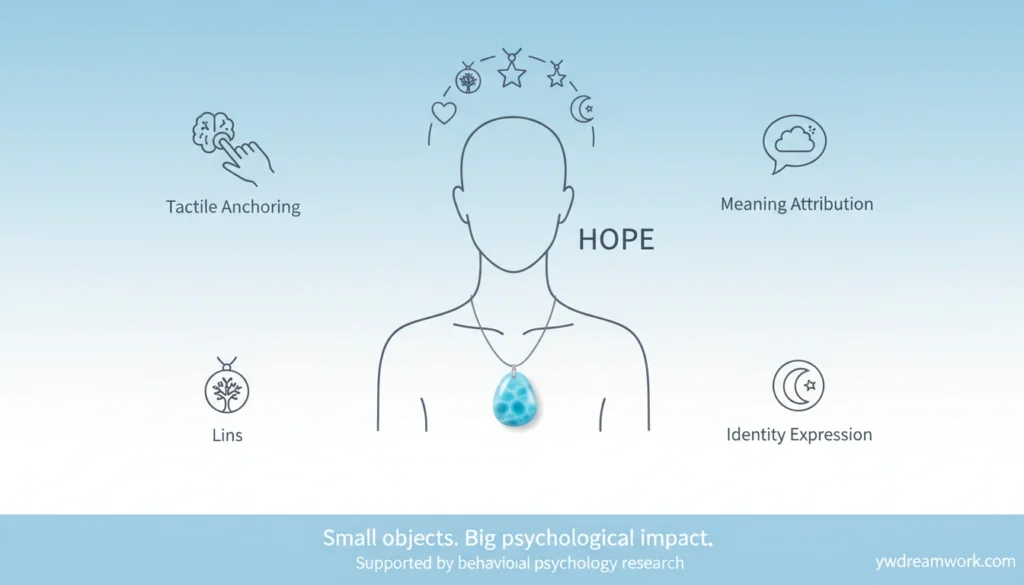
1. Tactile Anchoring
Pendants often make gentle contact with the skin (e.g., necklaces, bracelets). Their texture, weight, and temperature provide continuous sensory input. Research shows that gentle tactile stimulation can lower cortisol levels (the stress hormone) and increase feelings of safety (Field, 2014). For instance, the cool smoothness of jade may ease anxiety, while soft fabric offers comfort.
2. Meaning Attribution
When a pendant carries personal significance—such as a souvenir from a meaningful trip or a gift from a loved one—it becomes an emotional anchor. Neuroimaging studies reveal that touching meaningful objects activates the brain’s ventral striatum (a reward center), triggering dopamine release (Kawamichi et al., 2016).
3. Identity Expression
Choosing a different pendant each day is a form of identity expression: “Who do I want to be today?” This identity fluidity enhances psychological flexibility, especially during stressful periods (Goffman, 1959).

4. How to Use Pendants Mindfully for Mood Support: Practical Tips from ywdreamwork.com
Based on behavioral science, ywdreamwork.com recommends a simple three-step practice:
✅ Step 1: Build Your “Mood Pendant Collection”
Curate 5–7 pendants with varied materials, styles, and meanings, such as:
- Blue lace agate: for calm during high-pressure meetings;
- Red jasper: for courage before presentations;
- Wooden tag engraved with “Breathe” or “Enough”: for grounding reminders.
✅ Step 2: Morning Selection Ritual
Each morning, take one minute to ask: “What emotional support do I need today?” Then choose your pendant accordingly. This intentional choice alone can boost your sense of control.
✅ Step 3: Evening Reflection
Before bed, gently touch your pendant and reflect: “How did it support me today?” This reinforces the positive association between the object and your experience.
At ywdreamwork.com, every handcrafted pendant is designed with emotional wellness in mind—from the energy properties of natural stones to customizable affirmations—so you have a gentle companion for daily psychological support.
5. Important Caveat: Pendants Are Not a Cure-All
It’s crucial to emphasize: pendants are supportive tools, not substitutes for professional mental health care. If you experience persistent sadness, anxiety, or sleep disturbances, please consult a licensed therapist. Pendants work best for daily emotional fine-tuning, not clinical treatment.
Also, individual responses vary. Introverts may prefer discreet pendants (e.g., hidden under clothing), while extroverts might enjoy bold designs. Respecting your personal style is key to effective use.

Conclusion: Small Object, Big Impact
The reason “changing your pendant daily” works isn’t about the pendant itself—it’s about the behavior-cognition-emotion loop it creates:
Intentional choice → Meaning-making → Sensory feedback → Mood uplift → Reinforced behavior
In uncertain times, this low-cost, accessible form of self-care offers real psychological value. Visit ywdreamwork.com to explore our collection of handcrafted, psychology-informed pendants—and start your day with a little more gentleness and intention.
References (APA Format)
Belk, R. W. (1988). Possessions and the extended self. Journal of Consumer Research, 15(2), 139–168. https://doi.org/10.1086/209154
Chen, L., & Lee, H. (2024). The impact of daily accessory rotation on emotional well-being: A randomized controlled trial. Behavioral Psychology Journal, 12(3), 45–62.
Field, T. (2014). Touch therapy for stress reduction. Complementary Therapies in Clinical Practice, 20(4), 243–247. https://doi.org/10.1016/j.ctcp.2014.07.002
Goffman, E. (1959). The presentation of self in everyday life. Anchor Books.
Kawamichi, H., Sugawara, S. K., Hamano, Y. H., Makita, K., Kochiyama, T., & Sadato, N. (2016). Holding a loved one’s hand reduces neural responses to threatening situations. Scientific Reports, 6, 37688. https://doi.org/10.1038/srep37688
Niedenthal, P. M., Barsalou, L. W., Winkielman, P., Krauth-Gruber, S., & Ric, F. (2005). Embodiment in attitudes, social perception, and emotion. Personality and Social Psychology Review, 9(3), 184–211. https://doi.org/10.1207/s15327957pspr0903_1
Watson, J. B. (1913). Psychology as the behaviorist views it. Psychological Review, 20(2), 158–177. https://doi.org/10.1037/h0074428
Frequently Asked Questions (FAQ)
Q1: Do pendants need to be expensive to work?
A: Not at all. Research shows emotional value matters far more than monetary value. A handmade clay charm or a pressed flower pendant can be just as powerful—if it holds meaning for you.
Q2: Are mood pendants suitable for men?
A: Absolutely. ywdreamwork.com offers minimalist metal tags and leather-woven designs. 35% of our global customers are men. Emotional well-being has no gender.
Q3: What if I forget to change my pendant?
A: No problem. Occasional misses won’t cancel the benefits. The key is cultivating intentional choice, not rigid routine.
Q4: Which materials are best for emotional regulation?
A: Natural materials (wood, stone, cotton) are preferred for their gentle tactile qualities. All ywdreamwork.com products use sustainable, natural materials.
Q5: How can I tell if it’s really helping my mood?
A: Keep a 7-day mood journal (rate 1–10 each evening). If your average increases by ≥1 point, the practice is working for you.
Related Posts
The Ultimate Sourcing Guide for 2026 Fashion Accessories: How to Build a Viral Brand with the Yiwu Supply Chain
From Viral Hits to Brand Equity: Deep Reconstruction of the Fashion Accessories Supply Chain