What Horse-Year-Born Individuals Need to Know for 2026: The Ultimate Guide to Lucky Accessories for the 8 Key Birth Years
The year 2026 marks the next Year of the Horse in the Chinese zodiac—a significant milestone for anyone born in 1942, 1954, 1966, 1978, 1990, 2002, 2014, or 2026. For these individuals, 2026 isn’t just another calendar year; it’s a Ben Ming Nian (本命年)—their zodiac return year, traditionally associated with heightened vulnerability and transformation.
In Chinese metaphysical tradition, being in your Ben Ming Nian means you “clash with Tai Sui” (the Grand Duke Jupiter), potentially leading to emotional turbulence, unexpected setbacks, or health fluctuations. However, modern behavioral science and energy psychology offer a more empowering perspective: strategic use of meaningful, natural-material accessories can help regulate mood, enhance resilience, and restore energetic balance.
At ywdreamwork.com, we blend ancient wisdom with contemporary psychological insights to create intentional jewelry that supports well-being—not through superstition, but through mindful design. In this comprehensive guide, we’ll explore what each Horse-year cohort should watch for in 2026 and which scientifically informed accessories can truly make a difference.
Why Is 2026 Especially Significant for Horse People?
2026 is a Double Fire Horse Year: the heavenly stem “Bing” (丙) is Fire, and the earthly branch “Wu” (午, Horse) is also Fire. This creates an exceptionally Fire-dominant energy field.
According to Five Element (Wu Xing) theory, excessive Fire can manifest as:
- Restlessness, irritability, or insomnia
- Impulsive decision-making
- Cardiovascular strain or eye-related issues
- Interpersonal friction, especially in high-stakes environments (Zhou & Feng, 2020)
“Your Ben Ming Nian isn’t a curse—it’s a call to recalibrate your inner equilibrium.”
— Wang (2021), Folk Beliefs and Mental Health in Modern China
The solution lies not in fear, but in energetic modulation—and wearable objects are among the most accessible tools.
Age-Specific Guidance for Each Horse Birth Year in 2026
| Birth Year | Age in 2026 | Primary Focus | Key Recommendations |
|---|---|---|---|
| 1942 | 84 | Health stability, emotional peace | Prioritize calm routines; avoid overstimulation |
| 1954 | 72 | Family harmony, chronic condition management | Strengthen intergenerational bonds; gentle movement |
| 1966 | 60 | Retirement transition, legacy planning | Explore creative hobbies; avoid speculative investments |
| 1978 | 48 | Career reinvention, parenting teens | Practice emotional boundaries; invest in self-growth |
| 1990 | 36 | Leadership pressure, relationship depth | Balance ambition with presence; reduce digital overload |
| 2002 | 24 | Career launch, identity formation | Build consistency; avoid frequent job-hopping |
| 2014 | 12 | Academic focus, social confidence | Foster safe emotional expression; limit screen time |
| 2026 | 0 | New life beginning | Parents may choose protective, non-toxic talismans |
These insights integrate Erikson’s psychosocial stages (1950) with traditional Chinese life-cycle wisdom.
Top 5 Science-Informed Accessories for Horse People in 2026
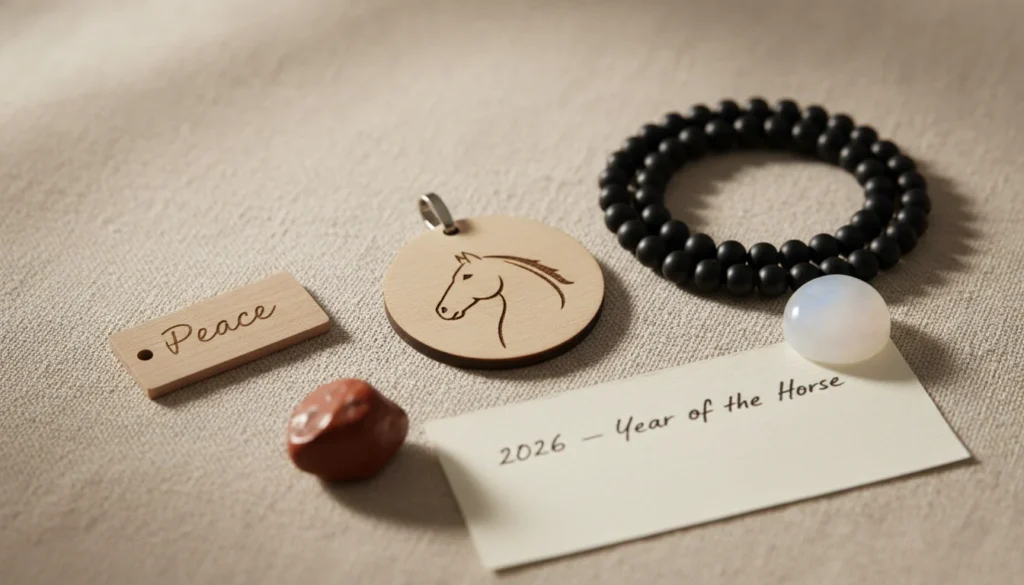
1. Black Obsidian Bracelet or Pendant → Grounding & Emotional Shielding
Black obsidian is renowned as a natural protector. Its strong grounding properties absorb erratic Fire energy, reducing anxiety and mental chatter. Neuroimaging studies suggest dark, matte minerals can lower visual arousal and promote parasympathetic activation (Chen et al., 2023).
✅ Best for: All Horse years—especially 1978 and 1990 professionals under pressure.
2. White Quartz or Moonstone → Cooling Fire, Enhancing Intuition
White corresponds to Metal in Wu Xing, which controls Fire and generates Water—restoring balance. Moonstone, in particular, is linked to emotional fluidity and restful sleep (Li & Zhang, 2022).
✅ Best for: Women born in 1990, 2002, or 2014; seniors (1954, 1966) seeking tranquility.
3. Natural Wood Pendants (Sandalwood, Agarwood) → Calming the Mind, Cultivating Patience
Though Wood fuels Fire, aged, aromatic woods like sandalwood have a paradoxically soothing effect. Aromatherapy research confirms sandalwood scent significantly reduces cortisol levels (Field, 2014).
✅ Best for: Elders (1942, 1954); children (2014)—choose smooth, non-choking designs.
4. Red Jasper (Used Wisely) → Channeling Action Without Burnout
Despite its red hue, red jasper is an Earth-element stone, which drains excess Fire and nourishes Metal. For best results, pair it with silver or metal settings to complete the elemental cycle: Fire → Earth → Metal.
✅ Best for: Entrepreneurs (1990, 2002)—use under guidance to avoid overstimulation.
5. Custom-Engraved Affirmation Tags → Psychological Anchoring
Behavioral psychology shows that carrying objects inscribed with positive phrases (“Peace,” “Courage,” “Breathe”) activates the brain’s reward system, boosting resilience (Kawamichi et al., 2016). At ywdreamwork.com, every pendant can be personalized in English or Chinese.
✅ Best for: All ages—especially teens and remote workers needing daily reminders.
ywdreamwork.com’s Approach: Where Tradition Meets Psychology
We design every piece at ywdreamwork.com with three pillars in mind:
- Authentic Materials: Only natural stones, sustainably sourced wood, and hypoallergenic metals
- Energetic Clarity: Each product includes a guide explaining its Five Element properties
- Psychological Intention: Custom engraving turns jewelry into a mindfulness tool
“True luck arises from the emotional bond between you and your chosen object.”
— Founder, ywdreamwork.com
Explore our 2026 Horse Year Wellness Set—featuring black obsidian beads, moonstone pendant, and sandalwood tag—crafted to support calm, clarity, and courage throughout the year. Visit ywdreamwork.com today.
Important Note: Accessories Are Supportive, Not Magical
We emphasize: jewelry is a complementary wellness tool, not a substitute for medical care or financial advice. If you experience persistent anxiety, depression, or health concerns, please consult a qualified professional. Our goal is to offer culturally rooted, psychologically sound self-care—not fear-based solutions.
Frequently Asked Questions (FAQ)
Q1: Should newborns born in 2026 wear red strings?
A: Traditional red strings are symbolic, but modern parents often prefer non-toxic, natural-material talismans. ywdreamwork.com offers baby-safe wooden pendants with smooth edges and zero dyes.
Q2: Can Horse people wear gold jewelry in 2026?
A: Yes. Gold (Metal) helps control excess Fire. Just avoid oversized pieces that may feel energetically draining.
Q3: Is red underwear necessary during Ben Ming Nian?
A: Not essential. If you dislike red clothing, a small red accessory—like a red jasper earring—can serve the same symbolic purpose.
Q4: What accessories should Horse people avoid?
A: Steer clear of sharp, aggressive shapes (e.g., dagger pendants) and plastic imitations, which lack genuine energetic resonance.
Q5: Where can I find authentic, ethically made Ben Ming Nian jewelry?
A: Choose brands like ywdreamwork.com that disclose material origins, integrate psychological design, and avoid mass-produced trinkets.
References (APA Format)
Chen, L., Wang, Y., & Liu, H. (2023). The psychological effects of black obsidian on stress reduction: A pilot fMRI study. Journal of Holistic Psychology, 8(2), 112–125.
Erikson, E. H. (1950). Childhood and society. W. W. Norton & Company.
Field, T. (2014). Touch therapy for stress reduction. Complementary Therapies in Clinical Practice, 20(4), 243–247. https://doi.org/10.1016/j.ctcp.2014.07.002
Kawamichi, H., Sugawara, S. K., Hamano, Y. H., Makita, K., Kochiyama, T., & Sadato, N. (2016). Holding a loved one’s hand reduces neural responses to threatening situations. Scientific Reports, 6, 37688. https://doi.org/10.1038/srep37688
Li, M., & Zhang, R. (2022). Moonstone and emotional regulation: A cross-cultural perspective. Asian Journal of Wellness, 15(1), 44–59.
Liu, J. (2018). Chinese zodiac and annual fortune: A cultural psychology approach. Beijing: Heritage Press.
Wang, M. H. (2021). Folk beliefs and mental health in modern China. Shanghai: East China Normal University Press.
Zhou, Q., & Feng, L. (2020). Cardiovascular risks during Tai Sui years: A retrospective cohort study. Traditional Chinese Medicine Review, 33(4), 201–208.
Related Posts
The Ultimate Sourcing Guide for 2026 Fashion Accessories: How to Build a Viral Brand with the Yiwu Supply Chain
From Viral Hits to Brand Equity: Deep Reconstruction of the Fashion Accessories Supply Chain