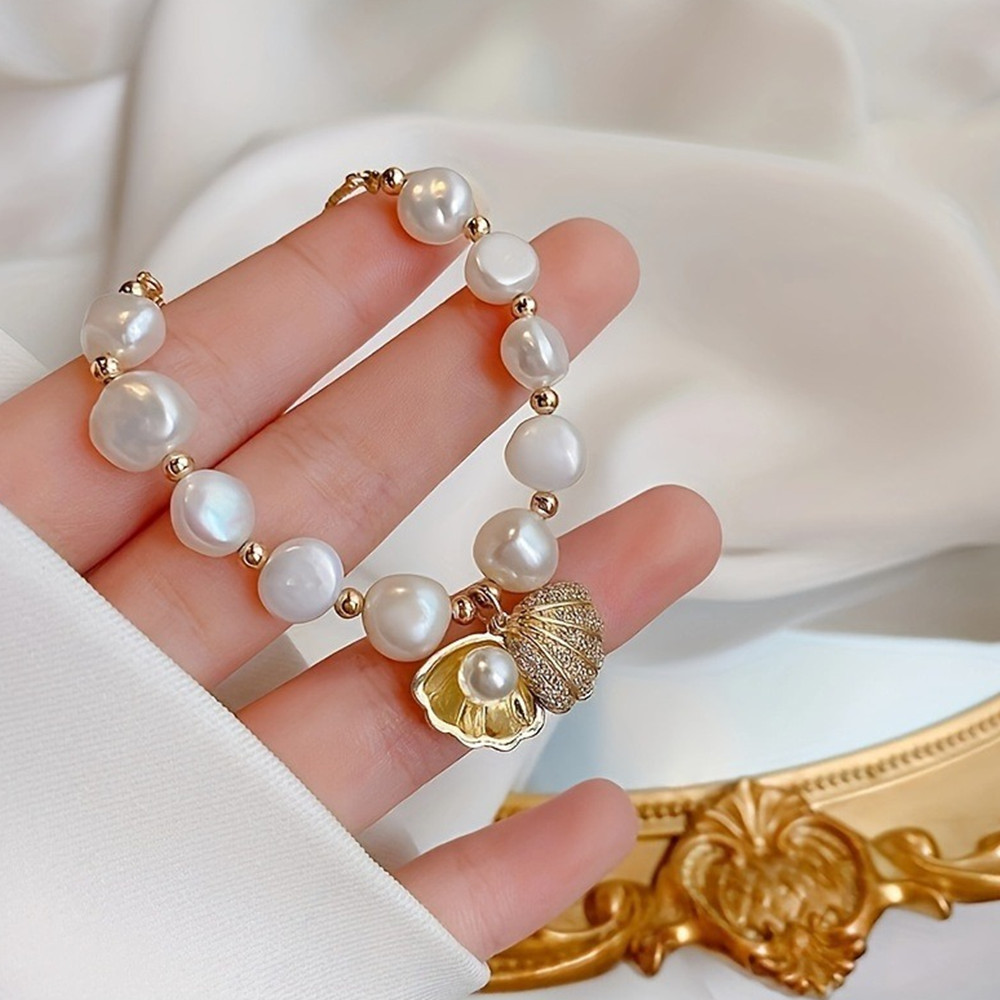
From Ochre to Gold: Why Do Humans Adorn Themselves? A 70,000-Year Journey of Body Decoration
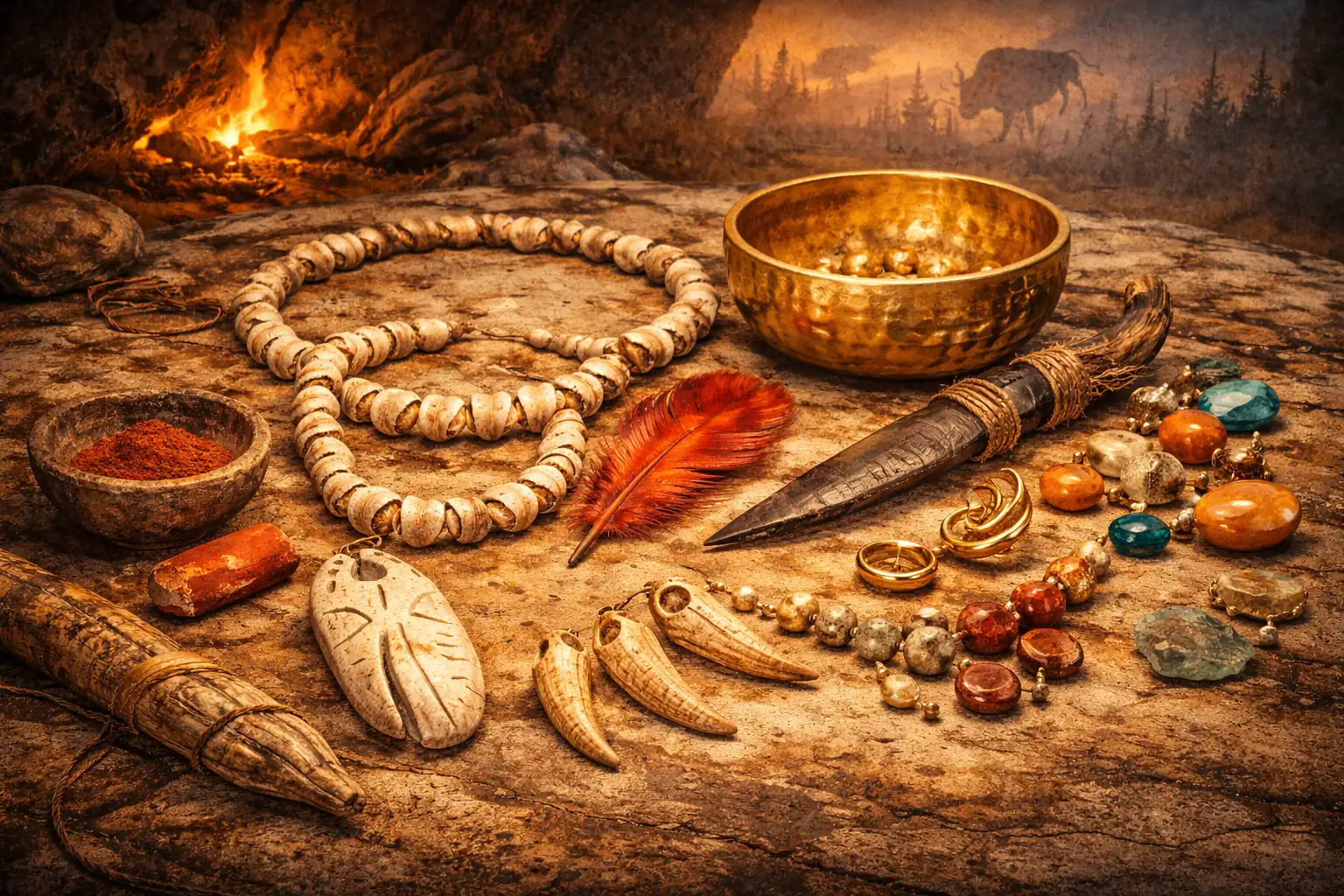
In the embers after the fire died, in the shadows of cave walls, early humans looked down at their own bodies—and picked up a shell, a pinch of red earth, a bone. Gently, they placed it upon themselves.
At that moment, we ceased to be mere flesh and became storytellers among the stars.
Today, an earring might be a 30-second finishing touch before the mirror. But at the dawn of civilization, a single ornament was a solemn ritual—woven with identity, belief, and existence itself.
Why do humans seek beauty? The answer lies not in philosophy books, but in a string of tiny shells from a South African cave 75,000 years ago—and in the rose-gold $3 pendant rolling off a production line in Yiwu today.
This is an unbroken conversation—ancestors speaking to us, using the body as parchment and adornment as language.
I. Beauty Is Not Vanity—It Is the Mark of Becoming Human
Archaeologists agree: what truly set Homo sapiens apart from other hominins wasn’t brain size—but the willingness to pour care into something with no practical use.
- In the dust of Contrebandiers Cave, Morocco, lie perforated fox teeth and seashells dated to 142,000 years ago—each hole deliberate, as if waiting for an invisible thread to bind them into a declaration (Dibble et al., 2022).
- In Skhul Cave, Israel, a teenage burial cradles ochre-stained sea snail shells around the wrist—red like dried blood, yet more eternal (Bar-Yosef Mayer et al., 2009).
- And in Blombos Cave, South Africa, a necklace of 41 Nassarius shells, each meticulously drilled, smoothed by wear, with traces of plant fiber still clinging inside—humanity’s first signature: “I am here.” (Henshilwood et al., 2004).
These were no accidents.
They reflect intentional symmetry, chosen luster, and journeys of dozens of kilometers just to collect a single shell.
Abstract thought, social awareness, aesthetic longing—these three threads wove the first fabric of “humanity.”
As archaeologist Ian Hodder once reflected:
“Adorning the body was humanity’s first way of saying, ‘I exist.’”
II. What Did Ancient People Use to Beautify Themselves? Nature Was Their Treasure Chest
Before metal was smelted or plastic invented, the Earth itself was a jewelry box.
1. Mineral Pigments: The Blood and Night of the Earth
- Ochre, that iron-rich red, was ground to powder and painted on cheeks, chests, and burial sites—it symbolized life, sacrifice, and sacred power. It gave motion to the bison leaping across Lascaux’s cave walls.
- Manganese dioxide, deep as midnight, lined eyes to sharpen the hunter’s gaze or let priests stare into the divine without flinching.
2. Shells and Bones: Gifts from Sea and Wild
- Shells, pierced and strung, flowed along silent exchange routes from the Mediterranean to East Asia.
- Mammoth ivory was carved into pendants; deer antlers shaped into amulets—not to boast of killing, but to honor: “We walked with giants, and now carry their strength close to our hearts.”
3. Feathers, Grass, and Floral Crowns: Poetry Woven by Wind
- Among Native American tribes, golden eagle tail feathers marked acts of courage—one feather, one story.
- In ancient Egyptian tomb paintings, men and women wear lotus and papyrus wreaths during Nile festivals—beauty as fleeting and radiant as morning dew.
4. The Dawn of Metal: Capturing Light
- Around 6000 BCE, Anatolian artisans hammered native copper into beads, chasing the dream of lasting shine.
- By 4000 BCE, the Varna Necropolis in Bulgaria buried a mortal under 6 kilograms of gold—light tamed, transformed into a cloak of power and divinity (Higham et al., 2007).
III. The Function of Beauty: More Than Ornament—A Survival Strategy
Beauty was never a luxury. It was a coded system embedded in survival:
表格
| Function | How It Worked | Archaeological Echo |
|---|---|---|
| Social Identity | Materials signaled who you were | In one cemetery, women wore turquoise; men, animal teeth |
| Spiritual Belief | Amulets warded off unseen forces | Shells buried with ritual offerings, guarding the soul’s path |
| Mate Selection | Symmetry = health and vitality | Evolution favors smooth, balanced ornaments |
| Trade Currency | Standardized beads acted as early money | Carnelian beads traveled from inland Africa to the Indian Ocean |
Beauty was humanity’s first universal language—understood at a glance, needing no translation.
IV. From Cave to Yiwu: Affordable Jewelry as the Democratization of an Ancient Urge
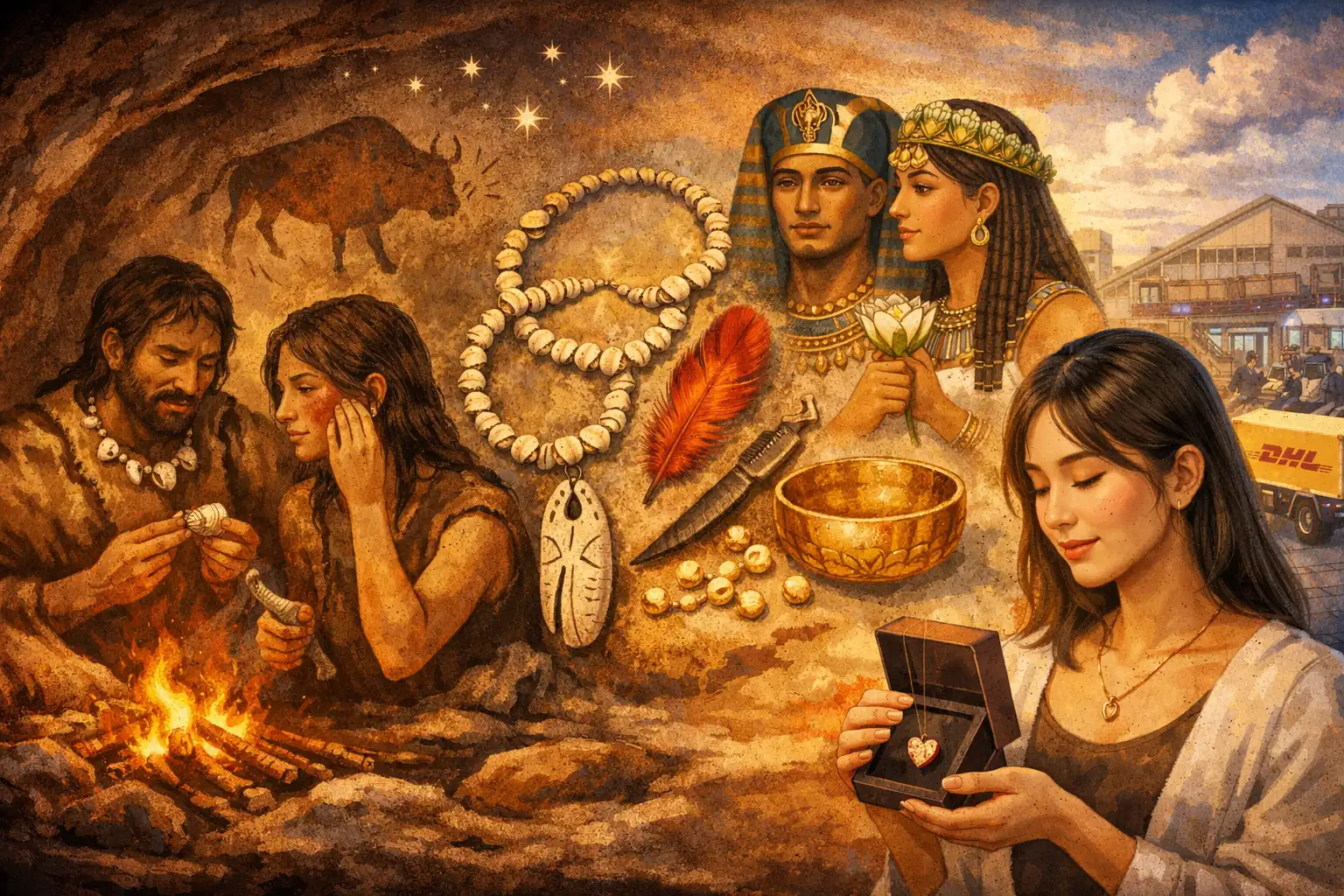
Today, when you click “Add to Cart” on YWDreamWork (ywdreamwork.com) for a $5 rose-gold necklace, you’re not just buying an accessory—you’re continuing a 70,000-year-old epic.
- That minimalist pendant whispers: “I choose quiet radiance.”
- The bracelet gifted on Valentine’s Day is a modern shell-token—“I wish to share time with you.”
- The earrings worn at graduation are today’s rite of passage: “I am ready to shine in my own way.”
Yiwu’s true significance isn’t “cheapness”—it’s liberation.
Once, gold belonged only to pharaohs; jade was the secret script of priests.
Now, eco-friendly alloy mimics that same glow, SGS-certified for safety, delivered to your door by DHL.
This isn’t compromise—it’s civilization’s generosity.
Beauty finally belongs to everyone willing to wear it.
Conclusion: To Love Beauty Is Humanity’s Oldest Freedom
Since that first string of shells 75,000 years ago, humans have used their bodies to declare:
“I do not merely survive—I choose to exist beautifully.”
Today, whether you spend $3 or $3,000 on jewelry, the impulse is the same—
to leave a trace of your light within a finite life.
And YWDreamWork’s mission is simple:
to ensure that light reaches every ordinary person’s everyday.
References (APA 7th Edition)
Bar-Yosef Mayer, D. E., Vandermeersch, B., & Bar-Yosef, O. (2009). Shells and ochre in Middle Paleolithic Qafzeh Cave, Israel: Indications for modern behavior. Journal of Human Evolution, 56(3), 307–314. https://doi.org/10.1016/j.jhevol.2008.10.005
Dibble, H. L., Aldeias, V., Archer, W., et al. (2022). New evidence for the earliest personal ornaments in North Africa. Science Advances, 8(15), eabn8464. https://doi.org/10.1126/sciadv.abn8464
Henshilwood, C. S., d’Errico, F., Vanhaeren, M., et al. (2004). Middle Paleolithic shell beads in South Africa. Science, 304(5669), 404–404. https://doi.org/10.1126/science.1089263
Higham, T., Chapman, J., Gaydarska, B., et al. (2007). The Varna Chalcolithic cemetery: Radiocarbon dating and chronological implications. Documenta Praehistorica, 34, 157–163. https://doi.org/10.4312/dp.34.14
Related Posts

The 2026 Global Influencer’s Guide to Sourcing in China: Unlocking Maximum Value Through Yiwu’s Multi-Supplier Integration Model

How Overseas Brands Build Private Label Jewelry Using Yiwu Suppliers (2026 Industry Guide)